Previous Story
Saudi Arabia: Rethinking its Soul
Posted On May 06 2004
Comment: 0
This article was syndicated in North America by Progressive Media Project. It was published by
Al Ahram (Egypt) May 6-12, 2004. The Daily Times (Pakistan) 05.06.2004, The Daily Star(Lebanon) 05.06.2004, The Globalist (USA), Q-News (UK) June/2004, The Muslim Observer(Michigan) and The Minaret (CA), The Providence Journal (RI) 05.15.2004, The Saudi-American Forum 05.07.2004.
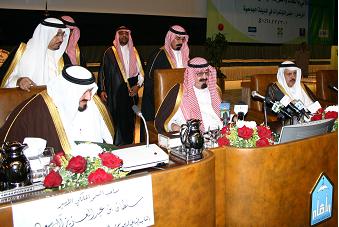
Crown Prince Abdullah himself inaugurated the conference to underscore its importance
I have just returned from Saudi Arabia, where I attended an international conference on terrorism (April 20-22) at the Imam Muhammad University in Riyadh – the global headquarters of Wahabism.
Imam Muhammad University is the factory where Wahabism is produced and serviced in Saudi Arabia. A large number of the Saudi clerics are educated and trained here. Nearly twenty thousand students study the core teachings of Abdul Wahhab, the founder of the Saudi Salafi movement, which is sometimes derogatorily and often popularly referred to as Wahabism.
In my previous in visits in1992, 1997 and 2000, I had found the Saudis to be proud of what they had become. They had covered a distance of nearly seven centuries on the back of oil in less than thirty years. They were arrogant, confident and sure of themselves and their place in the Muslim world and on the global stage.

The closed-door plenary on Wahabism. Scholars interacted with Saudi ministers and faculty of the I. M University.
But today they are confused, unsure, hesitant, apologetic and willing to accommodate. Some are belligerent even bellicose. But most people that I encountered, students, political elite, scholars, businessmen, professionals and cab drivers, are perplexed by terrorism within Saudi Arabia and by Saudis.
For a society, which was so remarkably free from a culture of self-criticism, I found the Saudi Arabia of today, more willing to listen; and that is the best news I have.
The conference itself revealed the extent and depth of rethinking taking place within Saudi Arabia. I was extremely critical of Wahabism as well as Saudi policies in closed-door sessions and found the Saudi scholars and the various ministers who were in attendance, open and willing to listen, sometimes they were in agreement, sometimes they were baffled, never offended. Some even encouraged me to speak more.
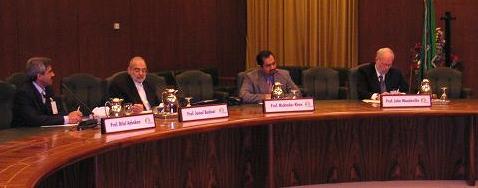
Some Foreign scholars who participated: From left, Dr. Bilal Aybakan (Turkey),
Dr. Jamal Badawi (Canada), Dr. Muqtedar Khan (USA) and Dr. Joe Mandaville (USA).
There were of course the usual number of sycophants and apologists, but even they seemed apprehensive and willing to question their own beliefs. Several American and British scholars criticized the lack of critical thinking and openness in Saudi education and we were all pleasantly surprised when they responded by asking for help in introducing critical thinking in their pedagogy.
I ran into a member of the Majlis-e-Shura (the Saudi pretense for a parliament) at a TV studio where I recorded a one-hour interview on Islamic democracy, and he berated me for not being more critical than I was. I listened to him lambast the university and Wahhabi clerics for being the source of the problem behind terrorism in Saudi Arabia. “All they teach,” he said, “is to hate those who are different.” “We are a country that is economically in the twentieth century and intellectually in the fourteenth century.” I advised him to speak to his country and King as he spoke to me, as often as possible and as loudly as possible.
The House of Saud has long relied on the Wahhabi movement for domestic control and legitimacy and on the US for international security. But after September 11, these two allies of Saudi Arabia are being perceived as antagonistic. The House of Saud could not have both as allies anymore.
It is now becoming apparent that the House of Saud has chosen America over Wahabism.
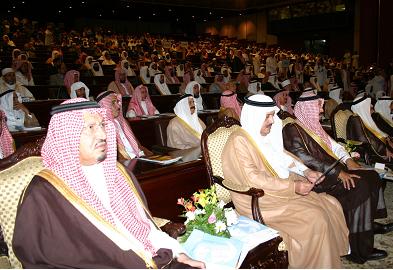
The conference was well attended. The Kingdom is finally taking things seriously.
It is determined to maintain its relations with the US and is actively seeking to reform Wahabism and reconstitute the domestic basis of its rule.
The Saudi society is composed of two types of elite; the conservative and religious elite and the liberal political and economic elite. For decades the latter had focused on retaining political power and milking the oil cow. In exchange for freedom to become rich, the ruling elite allowed the religious elite the freedom to preach. Without a cultural of internal criticism, without an engaging alternate elite, without the emergence of self-critical and reflective voices within the religious establishment, the specter of Wahabism has grown and now is out of the hands of those who nurtured it.
Wahhabi ideas are now so deeply embedded that neither the ruling elite, who had abdicated their normative responsibilities until now, and the religious elite who are afraid of what they have created, can rein it in. Any attempts at sudden reforms may upset the delicate balance within the society and empower those who have decided to use terrorism to replace both types of elite.
Saudi Arabia needs to push both social and political reforms without undermining domestic and regional stability. It must fast track its social reform and maintain a steady progress towards political reform. The promise of municipal elections must be kept and the momentum towards more representative and accountable governance must be sustained.