Previous Story
Karen Hughes and American Muslims: An Alliance Against Extremism
Posted On Sep 09 2005
Comment: 0
This article was published in The Daily Times [Pakistan, 09.16.05], The Daily Star [Lebanon, 09.24.05], Middle East Online [09.12.05], Pakistan Link [09.15.05], [Middle East Web [09.14.05], AltMuslim[09.10.05], American Muslim Perspective [09.09.05], The American Muslim [09.11.05], Naseeb Vibes [09.13.05], The Globalist [09.15.05], Afghanistan Sun [09.16.05], Big News Network [09.16.05], Official Wire [09.12.05], Iran Herald [09.16.05], and many more places.
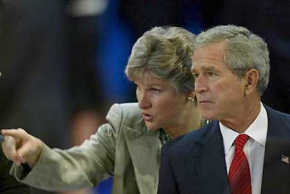
Can she point him in the right direction?
Karen Hughes, widely recognized as one of the most powerful people in America , essentially because of her proximity to and influence with the President, met with an influential group of American Muslim leaders in Chicago on September 1st and kicked off the 42nd annual convention of the Islamic Society of North America. She not only listened to them, as she had promised, but also engaged with them in a frank and open discussion and won many allies in the Muslim community.
One particularly classy gesture she made spoke volumes about the refreshing attitude that she is bringing to the job. After nearly three and a half hours of discussions, she graciously surprised everyone by offering to walk across to another venue to speak a few words of encouragement to the 300 volunteers who had worked hard to make the convention that typically attracts about 40,000 participants a huge success. It was easy to see why she was not deterred by Islamophobic critics who seek to subvert all endeavors at building an effective alliance against extremism, between American Muslims and American government.
The dialogue itself was interesting. It frequently revealed the perception gap between Muslims and the government on many issues. Ambassador Hughes was surprised that Muslims thought that the US continued to have the “same old policies” towards Palestine . She seemed genuinely amazed that American Muslims did not give President Bush sufficient credit for being the first American President for openly calling for a Palestinian State . American Muslims, on the other hand, were surprised that she was not fully tuned into the extent of marginalization, demonization and alienation that they routinely experienced, particularly with regards to the US government.
In her brief talk, Ambassador Hughes elucidated the four “Es” of her approach, Education, Empowerment, Engagement and Exchanges. She recognized upfront that one of her main tasks would be to empower American Muslims so that they could become more effective ambassadors for Islam in America and the US in the Muslim World. Her main message was contained in her opening statement: “You are the frontline in this [public diplomacy] because you are more credible than I am”. She suggested that American Muslims and her department should work together to (1) advance a positive vision of hope and opportunity to the Muslim World, (2) isolate and marginalize forces of intolerance and violence, (3) foster a sense of common intent and common purpose and common values.
Many Muslim leaders were a bit cynical going into the meeting. The current administration has closed more doors than it has opened for them. But they were heartened when during the meeting Ambassador Hughes expressed the need for government and civil society to do something that would make hate speech of any kind absolutely unforgettable. She recognized that like the radical ideologues in the Muslim world, there were American ideologues too who were preaching hatred against Islam and Muslims. Perhaps this issue can become a barometer to test how serious she is about improving relations. Will she, and can she, do something to check the Islamophobic messages that consistently come from evangelical leaders, conservative talk shows and columnists [usually supporters of the Bush administration]. I am sure she realizes that they ultimately will undermine her own efforts at public diplomacy.
As one who was involved in inviting her to the event and facilitating the dialogue, I am deeply committed to its success and hope that it will lead to more cooperation between American government and American Muslims. We are all excited and hopeful that her visit will make a difference. The Bridging the Divide initiative of Brookings Institution that I am associated with has strongly advocated that the first step towards arresting the growing chasm between the US and the Muslim World was through reducing the existing divide between American Muslims and the American government.
American Muslims are eager to work with her. They understand the vital necessity of dedemonizing the US in the eyes of Muslims worldwide and making it safe from terrorism and extremism in the name of Islam. On this issue American national interests and American Muslim communal interests are identical. But the Bush administration, the media and public opinion makers, particularly on the right, must understand that American Muslims cannot help dedemonize the US , until Islam and Muslims are dedemonized in the US .
We cannot be allies and effective on the frontlines of the battle against extremism if our own government will not trust us and if our fellow countrymen wage a campaign of disempowerment by leveling false, unsubstantiated and often malicious accusations against mainstream American Muslims and their institutions. American Muslims and their institutions are often deserving of criticism, but more for their incapacities and incoherence rather than for anything sinister.
Karen Hughes outreach to Muslims at the ISNA convention will go a long way in undermining the campaign of disempowerment and contribute to confidence building.
Her message however does have one fundamental philosophical problem. She seems to think that at some level just countering the geopolitical ideology and radical rhetoric of the extremists will result in winning the hearts and minds of Muslims and reducing the anti-Americanism that is swelling the ranks of Jihadis everywhere. This assumption is a recipe for failure.
Just because the Jihadis are wrong in claiming that Islam teaches violence and demands that every Muslim wage Jihad against all no-Muslims; it does not necessarily mean that US policies of supporting dictators (in Pakistan and Uzbekistan), maintaining close ties with monarchs and emirs, attacking countries on false assumptions and bring death and devastations to entire nations and practicing torture, are right.
If she listens closely to Muslims, and actually looks at the consequences of US policies in the Muslim World, Iraq for example, she will realize that US image in Muslim eyes will not be restored until there is a palpable change in US policy. US policies must change and if she can communicate that this change is genuine not cosmetic then we will see some positive progress.
Finally the Bush administration must understand that public diplomacy is not the sole responsibility of Karen Hughes and her associates in the State Department. Public diplomacy concerns should underpin how every agency, specially the CIA and the DOD, the American media and civil society leaders, conduct business with the Muslim World.