Previous Story
American Muslims: Call for Radical Transformation of US Foreign Policy
Posted On Feb 01 2005
Comment: 0
This article was published by the MuslimWakeup.com [Feb, 01, 2005], Pakistan Link [February 11, 2005], The Message magazine, Institute for Social Policy and Understanding and The Muslim Observer.
The importance of American Muslims to an effective and more peaceful US foreign policy towards the Muslim World was once again underscored at a policy forum in Washington DC on January 28th, 2005. US government officials, foreign policy experts, Muslim scholars and activists gathered at a standing room only event on Friday afternoon to discuss the deteriorating nature of US-Muslim relations and to brain storm how things could be improved. The open and very candid forum once again showed the great unease that American Muslims have about the direction of US foreign policy. It also highlighted the enormous willingness of American Muslim citizens and mainstream organizations, several of whom were represented at the forum, to work with the US government to improve its policies and its relations towards the Muslim World.
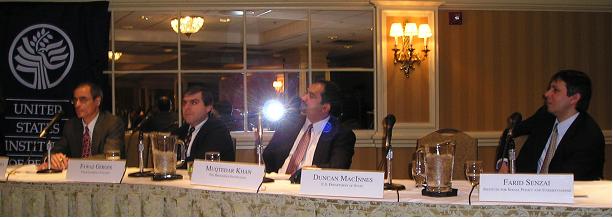
The Muslim World Initiative of The United States Institute of Peace (USIP), an independent, non-partisan federal think tank, sponsored the forum titled “The Role of American Muslims in Bridging the U.S.-Muslim Divide”. There is an emerging consensus among policy makers that the American Muslim Community can play a pivotal role in improving the relationship between the United States and the Muslim World. The Brookings Institution’s US-Islamic World Project and the Institute for Social Policy and Understanding provided the initial impetus and idea for the event.
Dr. Abdeslam Maghraoui, Associate Director of Research of Studies for the Muslim World, at the United States Institute of Peace, hosted and facilitated the forum. Featured speakers included Dr. Fawaz Gerges of Sarah Lawrence College and a Fellow at the Institute for Social Policy and Understanding), Dr. Muqtedar Khan (Chair of International Affairs at Adrian College and a Non-resident Fellow at the Brookings Institution), Mr. Farid Senzai (Fellow and Director of Research at the Institute for Social Policy and Understanding) and Mr. Duncan McInnes (US State Department).
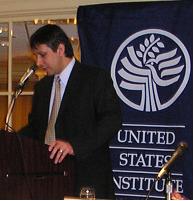 Farid Senzai discussed the inadequacy of past US diplomatic efforts and the administration’s gimmicky and counterproductive tactics used since 9/11. This was partially due to the limited funds devoted to public diplomacy as well as the inability of the Bush administration to produce a comprehensive strategy for public diplomacy. He criticized the government for its lack of understanding of the culture and the history of the people it purported to influence. In his view the U.S. government needs to develop a better grasp of our target audiences.
Part of the problem, he argued, was the lack of professional staff with the language and regional expertise for public diplomacy in Arab and Muslim societies. He concluded by pointing out that winning the “hearts and minds” of the Arab and Muslim world won’t be won by tricks and manipulation, but by honesty from a country that believes in its own values – and acts on them.
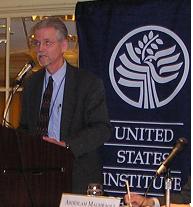 Mr. Duncan MacInnes outlined US government’s current public diplomacy effort and the need for greater communication between the various government agencies and the Muslim community in the United States.
He emphasized the need to continue to tell our stories to one another and encourage dialogue and exchange — efforts based on mutual learning and mutual understanding. During his talk and in the question and answer sessions, which he handled bravely, he emphasized the need for American Muslims to be persistent and continue to speak out with their concerns. Several Muslim organizations’ representatives who feel that they have no say in their government’s policies repeatedly accosted him. His message to them was clear — do not give up, be persistent, and continue to engage the government at various levels. After all that is the role of the civil society.
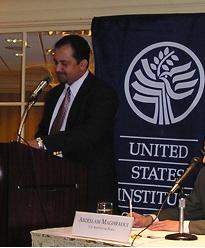 Muqtedar Khan discussed the role that the American Muslim community might play in helping bridge the growing divide between the United States and the Muslim world.
He spoke critically about the Bush administration’s lack of understanding of public diplomacy and advised the administration to make a more concerted effort to work with American Muslims who are committed to improving US-Muslim relations. He pointed out that the administration saw diplomacy not as a foreign policy instrument but as a means to damage control.
He attributed the imbalance of power between various executive agencies, particularly the domination of the defense department on Foreign policy and intelligence issues, as the primary reason for failure of US diplomacy. He asserted that as long as the administration excluded Muslim input, and if Muslims did not actively provide it, US foreign policy in the Muslim World would remain misguided.
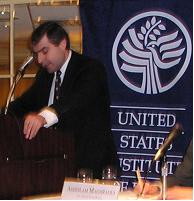 Fawaz Gerges called for “a dramatic transformation” in the United States’ public diplomacy effort. This transformation requires changes in both substance and form, including a transformation of our policies towards the region. In his view American policies have contributed to the very real challenges we face today in the Muslim world. New policies are required to reverse mounting anger and rage. While we cannot and should not expect to attract the good will of everyone in the region, especially of the violent groups, a change in our policies will dramatically improve our status abroad.
His most important point was that the bad US policy was not a function of ignorance but of a lack of political will. He pointed to several US government studies that had blamed US policies for bad US-Muslim relations and called for radical transformation of its policy approach, but the administration was not paying heed to its own findings.
The forum continues from a previous conference held in December 2004 at the Brookings Institution, from which the American Muslim Group for Policy Planning (AMGPP) emerged. The group seeks to first bridge the gap between American Muslims and American policymakers in order to facilitate better policies to bridge the divide between the US and the Muslim World.