Previous Story
Soft voice, strong message
Posted On Apr 02 2006
Comment: 0
Students, world leaders seek UD professor’s thought-provoking views on Muslim politics, religious extremism
By GARY SOULSMAN
The News Journal
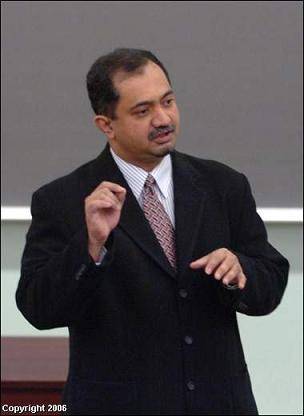 The BBC wanted a free-thinking Muslim to talk about the implications of the life-threatening stroke of Israel’s Prime Minister Ariel Sharon.
So they called Muqtedar Khan at the University of Delaware.
The BBC reached Khan, an assistant professor in the department of political science and international relations, in the midst of a winter-session class in Gore Hall. Khan called a five-minute break, did an interview over his cell phone, and then reconvened class.
A preppy dresser with a trim beard, the soft-spoken Khan caught the world media’s attention after Sept. 11, 2001. About a month after the attacks, he posted on his Web site, www.ijtihad.org, an impassioned essay about why the Muslim faith should not be considered a license for terror.
Since then, the essay has been reprinted in more than 100 publications, including USA Today. He’s dashed about the world to conferences, written op-ed pieces, spoken to reporters, collaborated on books, published his own journal (Muslim Public Affairs Journal) and taught classes about his views.
He’s shaken hands with Prince Charles, who was so impressed by Khan’s remarks at a Georgetown University conference on religion and politics that he came over to say so.
Khan is now such a sought-out voice on Islam and international affairs that he’s been anointed “one of the 40 most influential Muslims in America” by Majalla, an Arab weekly news magazine in London.
He’s certainly not afraid of giving his opinion — and he’s not afraid of reaction.
“I speak my mind and later run into people who want to kiss me or break my legs,” he jokes.
Belief in open dialogue sparks debates
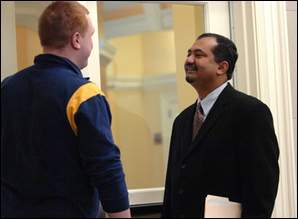
Muqtedar Khan weaves personal history into political history to teach University of Delaware students how religion and government influence culture.
Khan helps others understand his faith and its connection to world politics, says John Esposito, founding director of the Center for Muslim-Christian Understanding at Georgetown University. Khan was his student.
His belief in open dialogue, rather than unthinking submission, is like that of parishioners in many Protestant traditions.
“I don’t take other people’s opinions as divine. They are opinions, and reasoning can be faulty,” Khan says. “I say, let’s have a debate. I’m not afraid of offending God by using my mind.”
Or, as he likes to say: “I think, therefore, I am a Muslim.”
Even the name of his Web site, Ijtihad, is a word that speaks of the need for independent thinking on Islamic law.
“In childhood I realized that he who is afraid of God is afraid of no one else,” Khan said. “Submission to Allah gave me complete freedom from everything.”
Khan’s rise to fame began in the wee hours of the morning Oct. 5, 2001, when he rose from his bed in Adrian, Mich., where he was teaching at Adrian College, to write about the terrorist attacks.
Many Muslims were still arguing that it was far from clear that Islamic extremists had hijacked the planes that brought down the World Trade Towers. Khan felt extremist involvement was clear, and he was offended by the silence of so many.
Khan saw that silence as denial, and he wanted to tell Muslims that the values of American democracy are aligned with the highest values in Islam — peace and tolerance.
So he sat at his computer and banged out “Memo to American Muslims” and posted it on his Web site. It was soon read by millions.
In the memo, Khan chastised Muslims for failing to stand as a moral force to prevent the Sept. 11 attacks. He demanded that they reclaim Islam’s higher goals.
And he accused Muslims of hypocrisy.
“Muslims love to live in the U.S. but also love to hate it,” he wrote. “Many openly claim that the U.S. is a terrorist state, but they continue to live in it. Their decision to live here is testimony that they would rather live here than anywhere else.”
If the United States is such a terrorist state, he added, then go back to where you came from and see how you are treated.
It wasn’t long before the world’s papers — from The New York Times to The Daily Times in Pakistan to the Nagasaki Post in Japan — wanted him to write op-ed columns. In April, his new book “Islamic Democratic Discourse: Theory, Debates, and Philosophical Perspectives” will be released by Lexington Books.
Mark Miller, a fellow professor in UD’s department of political science and international relations, marvels at the pace of Khan’s life. One day he’s talking to Prince Charles, the next it’s the former prime minister of Pakistan, Miller notes.
Yet Khan insists that he was not the most popular person in the Muslim world after he wrote the open memo.
Many longtime friends would not speak to him. Others urged him to keep his thoughts to himself.
“I had threats on my life from overseas,” he says. “But after six or seven months things had changed so much that prominent American Muslim organizations were saying what I had said.
“This has helped me to see that I am grounded in my thinking. Though I am a liberal, I am in the mainstream.”
And he worries about the lasting impact of the war in Iraq.
“Muslims look at the U.S. as going back to its old ways, using it as an opportunity to dominate and destroy,” he says. “The sympathy for the U.S. that followed 9/11 has vanished.
“And while President Bush thinks he’s brought freedom and democracy to people in Iraq, others see chaos.”
History, politics, seasoned with humor
It’s 9:05 a.m. in the amphitheater of Gore 103. Khan is about to start a class in comparative politics, an introductory class that compares different forms of governments and politics.
He looks the part of a successful immigrant, in his gray slacks and buttoned black jacket. He tends to speak softly, causing some students to lean in to hear.
His accent is Indian. One of three children, Khan grew up speaking English. His father was in the military, stationed in Hyderabad, the capital city of the Indian state of Andhra Pradesh. Khan attended a Catholic school, where he was taught well and sometimes caned. He also was tutored in Islamic studies, mostly at home.
In his UD class, as Khan talks about the history of India, he weaves in personal history, too. Typically, he says, a colonial power imposes culture on people.
“Look at me,” he jokes. “I’m a Kmart Englishman. I think in English, drink tea and play cricket.”
UD students say they like the mix of history, modern politics, personal revelation — all leavened with humor.
Jon Osborn, a UD senior and evangelical Christian, says that Khan is also open and engaging.
“I feel like he’s a kindred spirit,” Osborn says. “Both our religions talk about a true follower of the faith being like a voice crying in the wilderness.
“To me, Professor Khan is one of those voices.”
False starts lead to true calling
One of Khan’s first jobs was in marketing and advertising with Procter & Gamble. But he hated working in marketing, and he felt an existential anxiety that reminded him of Camus’ novel “The Stranger.” “I kept asking, what is the meaning of life?” he says.
In the meantime, Khan met a Hindu woman, Reshma Mohile, while teaching a seminar in hospitality management. She found him charismatic.
“I joke that he could sell fleas to a dog,” she says.
She converted to Islam. Khan says his family did not approve. And, to the consternation of his mother and father, Khan gave up a comfortable life in India’s corporate world and moved to the United States with his wife.
There he studied business management at Florida International University. But after a year, that course of study ended, too. He found it unstimulating.
“We were trained as technicians to maximize the profit,” he said.
Even if wildly successful, he realized, he would not be happy as a Lee Iaccoca.
A course in political science shifted his focus to international affairs.
“I choose it because it’s like a garbage can,” he jokes. “You can do what you like and call it international studies.”
A full scholarship and a stipend to Georgetown University helped make it possible for him to change his course of study and, now, his life. At Georgetown, he studied with one of the most respected American experts on Islam — Esposito.
Today, he’s so enthused by the opportunities to make his voice heard that his wife worries about him sleeping only four hours a night and wearing himself out. He does, however, make it a point to make time for activities, such as crafts and reading, with their children — Rumi, 7, and Ruhi, 3. The family also watches movies together. One favorite is “Water World,” Kevin Costner’s futuristic “Mad Max” on water.
The family’s house is in Frenchtown Woods in Glasgow, only a few minutes’ commute to the UD campus. And Khan likes that he can take the train to New York or drive to Washington, where he’s a fellow at the Brookings Institute, and be back the same day.
With so many blessings, Khan says, he’s intent on giving back to his adopted home.
“If I want to have a good life, America has to be a good place,” he says. “That’s why I work so hard at telling truth.”
Contact Gary Soulsman at 324-2893 or gsoulsman@delawareonline.com.