Previous Story
India: Where Cultural Heritage is a Fundamental Right
Posted On Jan 26 2012
Comment: 0
The America of today has its roots in the India of Mahatma Gandhi – Barrack Obama
Today, January 26th, is Republic Day; one of India’s two major national holidays. India became independent in 1947, but its constitution was ratified on this day in 1950.
India, the biggest democracy, and U.S., the oldest democracy, are rapidly becoming close allies. It is possible that a global showdown with China may eventually cement a very special relationship between them.
India was born a democracy, and unlike the U.S., it was born with universal suffrage. Most countries fought wars for freedom, but India achieved its independence primarily through nonviolent means. India’s independence movement was led by Mahatma Gandhi, whose example of nonviolent struggle, inspired Dr. Martin Luther King Jr., to insist on nonviolence as the means for the American civil rights struggle in the 1960s.
President Obama acknowledged this when he paid homage to the Mahatma in 2009 – “Gandhi’s teachings and ideals, shared with Martin Luther King Jr. on his 1959 pilgrimage to India, transformed American society through our civil rights movement. The America of today has its roots in the India of Mahatma Gandhi and the nonviolent social action movement for Indian independence which he led.”
Today, the Indian constitution has been in force for sixty-two years. It lacks the simplicity and clarity of the US constitution. It is too long and full of too many details best left to the legislature. But one of its main sources is the US Bill of Rights. The Indian constitution has an inventory of rights that must be protected. They are called Fundamental Rights and they include everything in our Bill of Rights and two additional ones. The additional rights are right to education and the right for minorities to preserve their cultural heritage.
India is a country of profound contradictions. It took to democracy and religious pluralism like fish to water, but religious riots and autocratic tendencies persist in its political culture. It taught the world the way of ahimsa (nonviolence), but violence pervades its civil society and it chose to become a nuclear power. It opted to become a secular state, but outside of the Muslim World, the biggest religious political movement (Hindutva, Hindu Nationalism) thrives in India. It has made a habit of giving the world brilliantly successful women, a head of state like Indira Gandhi, sports women like Sania Mirza, beauties like Miss Worlds and Miss Universes – Lara Dutta, and Aishwarya Rai, writers like Arundhati Roy, and humanitarians like Mother Teresa. But India also takes the prize for female infanticide. Thousands of female fetuses are aborted every year in India.
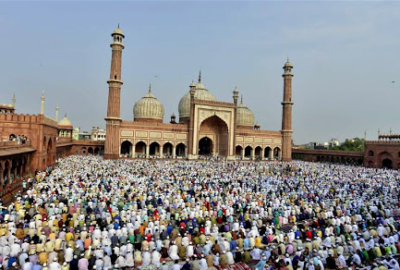
It has been nearly twenty years since I left India and my two visits to India combined were for less than twenty days. But on days like today, I can’t help but ruminate about India. I remember vividly, waking up many a day to several calls for prayers, there were (five mosques within walking distance of my house) and then after ablutions, walking to the nearest mosque for prayer while listening to Hindu chants blaring on the loud speaker from a nearby temple. Last summer, I was in Morocco and I regularly walked to the mosque for the morning prayers, but somehow, there was something missing, the accompanying sound of Hindu devotional music.
That is one thing about India that I miss in the US the most. The cultural overlapping of different religions and traditions into a single complex and rich music of life that makes your being dance. Dance until you forget yourself and become one with the Other.
The US is undoubtedly more diverse and cosmopolitan than India. There is a mini-India; indeed the US is a microcosm of global cultures. But the common ground we share is a sterile, culture free zone, politically correct and primarily driven by material interests and liberal politics. We forge political and financial partnerships and even have inter-cultural marriages. But there are no marriages of cultures, no overlapping of traditions. The US is more like an office building with multi-national corporations, where people from every country works, each one of us wearing pin stripe suits, and red ties, carrying black berries. But the India I remember was like a village with homes without walls, and three of your neighbors wore your best coat to their weddings.
But wait, for those like me, who live on the borders of civilizations, and dream of a syncretized global cultural, there is hope.
As I write this article, I see my son, born in Virginia, and my daughter, born in Michigan, across the room, eating samosas with chutney, tapping their feet to Bollywood music and watching with unadulterated delight excerpts from Stephen Colbert’s show on their iPads.