


Previous Story
The Myth of Secularism
Posted On Jan 01 2004
The Myth of Secularism:
Religion and Politics are Mutually Constitutive
Had Allah willed He could have made you all one community? But He made you as you are (diverse) as a test. So vie one with another in good works. Unto Allah you will all return, and He will then inform you of the meaning of differences within you.
[Quran 5:48].
Identity and Politics are Inseparable
As a Muslim intellectual living in the West, researching and teaching political theory and political philosophy, I have always marveled at the durability of the idea of secularism. For a civilization that boasts considerable sophistication in most areas, to assume that politics and religion constitute two separate realms or that the two can be separated is uncharacteristically naïve. This belief, not in separation of church and state, but in the separability of church and State, in my opinion is one of the enduring myths of modernity. This myth rests on the false assumptions of pure politics and pure religion. Secularism is a device that seeks to protect religion from the corruption of politics and politics from becoming usurped by religion.
All core issues are not only normative in nature but also impinge on individual and collective identities. Neither the conception of the individual self nor the construction of the collective self is free from political or religious considerations. Even in societies that were anti-religious such as the former Soviet Union and present day China, or more secular than the US, such as France and Turkey, religion remained an important political issue and politics shaped the way religion was practiced. Christianity played a significant role in the collapse of communism in Eastern Europe and Islamists found a way to come to power in secular fundamentalist Turkey. The place of religious symbols in public sphere, whether it is Hijaab (Muslim headscarf) in French public schools or the Ten Commandments in American courts, remains contested primarily because there is no consensus on the exclusion of religion from public sphere anywhere.
Not only does religion play a role in politics, but politicization of religion is also a common occurrence. Notice how some Republicans are relishing the idea of taking Howard Dean to cleaners, if he were to become the democratic nominee in the coming Presidential elections, by painting him as an advocate of gay marriages. This would be a clear case of exploiting religious sentiments (that marriage is a divine institution) for political gains. I have noticed that often, American politicians try to couch their religious motivations in secular terms while advocating specific policies. A very good example is the unyielding support for Israel and Israel’s occupation of West Bank and Gaza among certain Republican politicians with evangelical connections. While they support it for Biblical reasons they justify it by arguing that Israel is the “only democracy in the Middle East.” I often wonder if their support for Israel will stop if Israel became less democratic, or it can be shown that some people within its borders do not enjoy basic democratic rights?
In the Muslim world on the contrary, legitimacy comes from Islam and therefore many politicians justify material motivations using Islamic cover. While religious politicians in the West often use secular discourse for legitimacy, Muslim politicians deliberately Islamize mundane issues for the same reason. Notice the Islamization of Saddam Hussein’s rhetoric in the first Gulf War. Religion in the West lacks legitimacy in the public sphere and must therefore be concealed, in the Muslim World all legitimacy derives from Islam hence Islam is used as a justification for politics.
There are two reasons why religion and politics are intertwined. The first is the increasing use of complex discourses for the purpose of legitimization. Today all politicians seem to follow the Machiavellian dictum – it is not important to be just, it is important to be seen to be just – and therefore politicians and political parties and regimes produce discourses to legitimize their goals and strategies. It is in the production of these discourses that religion either underpins political logic are camouflages politic motivations, depending upon the cultural context.
The second reason and perhaps the most important reason why religion will always play a role in crucial issues is the important role that religion plays in identity formation. All political issues that are important eventually affect individual and collective identity and in the process trigger religious sentiments. As long as religion plays a role in the identities of people, it will play a role in politics.
Self-Restraint or Constitutional Limits
Both Governor Mario Cuomo and Congressman Mark Souder link religion with private and public morality. They both agree that it is difficult for a believer to divest herself of her religious values while also serving in a public capacity. However, it is interesting to see how each of them uses separate mechanisms to limit the impact of religion in public policy. Governor Cuomo argues that politicians must exercise self-restraint and only allow those religious values that are universal in nature to influence their politics and abstain from allowing particularist values to shape their agenda. Congressman Souder rejects the notion of a natural God and common religious values by suggesting that the uncommon is more important than common ground between religions. This is an interesting contrast between identity and difference. Cuomo seeks to overcomes differences by seeking the identity of all faiths while Souder celebrates difference in search of identity.
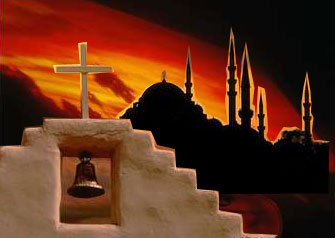
The Cross and the Mosque
As a religious minority in America, I felt very uneasy with Congressman Souder’s response to the question about the fears of non-Christian religious minorities. To put it bluntly his response that because Christianity is so diverse Christians will never manage enough consensus to impose their religious values over others seemed evasive.
What if they do agree upon some basic issues, what if the Christian Coalition does manage to construct a broad coalition to deprive Islam, Hinduism and Buddhism the same legal protections as Christianity (for example in England blasphemy laws protect Jesus but not Muhammad)? When Muslims repeatedly requested President Bush to condemn anti-Islam (Islamophoebia)[i] bigotry from prominent Christian figures such as Rev. Pat Robertson, Rev. Franklin Graham, and Rev. Jerry Falwell, the President hedged for weeks, because these individuals have a large following that translates directly into political power at the ballot and in campaign fund raising.
In an era when religious minorities in America are becoming extremely nervous about the relations between Christian Right and the Republican establishment which controls both the White House and the Congress, a plain, unequivocal statement — “we will not impose Christian beliefs on non-Christians,” – would have gone a long way. Congressman Souder makes the point that as a Christian politician he is conscientious enough to fulfill his constitutional obligations. He will abide by the constitution since he has sworn to protect and abide by it. After listening to Governor Cuomo’s eloquent argument for self-restrain, I wish someone had asked Congressman Souder would he self-consciously abstain from advocating the amendment of the constitution to make his religious beliefs the law of the land. In a democracy what stands between minority rights and majority domination are constitutional guarantees, which are themselves at the mercy of good intentions of the majority.
The Muslim World today is experiencing deeply divisive and traumatic religious resurgence. This is not a venue to discuss them, but I think it is important to draw an interesting parallel that is prompted by Congressman Souder’s claim that his faith is a worldview. The Islamists too make this claim. They argue that Islam is not a religion, it is a worldview and they even compared it to other ideologies and worldviews such as capitalism and communism. Islamists’ have penned tons of books comparing Islam with communism, socialism, capitalism, liberalism and democracy to prove that Islam not only has something to say about every aspect of life, but also whatever it may have to say on any subject is necessarily superior to what other ideologies have to say on the same subject. This for them is an article of faith. Claims about religious creeds as an all-encompassing worldview have the potential to blossom into totalitarian ideologies.
The two politicians demonstrate contrasting models. Governor Cuomo is a model of statesmanship as he chooses wisdom over parochialism and seeks to exercise self-restraint on personal beliefs in search of common public values. In doing so he chose to become a generic religious politician and not just a Catholic politician. Congressman Souder on the other hand is a model of citizenship where his commitment to the US constitution proscribes the role of his religion in politics. But his view that his faith is a worldview and a true worldview, including those elements that question the authenticity of other faiths, places the constitution in jeopardy. I fear that his citizenship will prompt him to uphold the constitution, but his Christianity will compel him to change the constitution whenever possible to accommodate his beliefs. The statesman will always be the ally of religious minorities in pluralist democracies, but the Christian citizen is an imminent threat to constitutional guarantees of freedom from religions.
Islam and the Political Sphere
O humanity! We have indeed created you from one man and one woman, and have made you into various nations and tribes so that you may know one another
[Quran 49:13].
And let there be amongst you a group of people who invite to goodness, encouraging that which is right and forbidding that which is wrong; it is they who are the successful
[Quran 3:104].
The two verses from the Quran cited above and the one with which I began this chapter make two important points: 1). Diversity is a consequence of divine designs and 2). Muslims have an ethical role to play in the public sphere. The verses 3:104 in the opinion of some Muslims scholars is a Quranic call for political parties to emerge and play a normative role in the public sphere. I have argued that the mission of Islam/Muslims in the West can be to become the moral conscience of free societies. The objective of Muslim participation in Western, particularly American politics should be to encourage what is right and forbid what is wrong rather than seeking to advance the geopolitical agendas of the Muslim World.
 Islamic sources recognize racial and ethnic and even religious differences and advocate a culture of inclusion and equality. However, there are also sources that lend themselves to exclusivist politics. Consider the following verses:
Those who believe (in the Qur’an), and those who follow the Jewish (scriptures), and the Christians and the Sabians,- any who believe in God and the Last Day, and do good deeds, shall have their reward with their Lord; on them shall be no fear, nor shall they grieve (Quran 2:62 and 5:69).
And if one seeks a religion other than Islam, it will never be accepted from him; and he is among the losers in the Hereafter (Quran 3:85).
Today liberal and radical Muslims are divided over which of the above two verses should determine Muslim relations with other faith communities. The first verse is inclusive and clearly indicates that those who are good people have nothing to worry. And if one treats the word “and” as separating sets of people, Muslims and Christians… and those who do good deeds, one could even argue that atheists who do good deeds, such as stand up for justice, help the poor etc, may have nothing to fear. This status of fundamental moral equality of all people can become the basis for political equality in a multicultural, multi-religious society.
But radical Muslims who believe that only Islam has the Truth and only good Muslims are good people, rely on 3:85 exclusively arguing that it is not only the ultimate source for defining Muslim-non-Muslim relations but also abrogates both 2:62 and 5:69. Some Muslim leaders in Dallas, Texas now object to my speaking there because I once rejected this idea of abrogation of Quranic sources that radicals do not like by arguing that, the only reason why God repeated 2:62 in 5:69 was to ensure that bigots did not use 3:85 to annul 2:62. How can one verse abrogate two verses from the same sources was my point. Muslims must realize that not only does Islam influence politics, but politics too shapes what Islam is.
Today Islam has once again become the ethical language of the Muslim World. Islam will not only guide Muslim public discourse but also Muslim conception of what is ethical politics. The Iraqis today have managed to make President Bush an advocate of Islamic democracy. European Muslims are making sure that Europe’s foreign policy balances US’ pro-Israeli stance in the Middle East. As Muslims become a political force in America, they will most certainly seek to redefine the role of religion in American politics. I only hope that an inclusivist rather than an exclusivist understanding of Islam shapes American Muslim politics. I hope 2:62 prevails over 3:85 and that Muslims seek to emulate Governor Cuomo and not Congressman Souder.
Final Thoughts
The reason why the myth of secularism is so precious to modernity is not its potential to separate religion and politics but its potential to advance a framework for dealing with religious diversity under conditions of unequal power. In perfectly homogenous societies, it does not matter if the state is influenced by religion or not. It is only when there are other faith communities, or other interpretations of the same faith that the state can become an instrument of religious oppression in the hands of the majority. But religion disguised as national interest or secular reason can play havoc with minority rights.
As religion becomes more assertive, and religious zealots become more adept at “playing the system” then constitutional guarantees become meaningless if even the constitution of the Supreme Court can be rigged. In the modern West, the best examples of freedom and protection of religious minorities has come under the reign of secular democracies, in the Muslim experience the same has happened under the reign of Islam. Today as all religions experience revivals we must find a ways to guarantee religious freedom without proscribing the scope of religion. Ultimately the plight of the minorities is at the mercy of those who are enlightened among the majority and are willing to break ranks with their kind to stand up for equality and justice for all. Systems are safe only as long as we strive everyday to keep them safe.




Pingback: Can Religion Play a Positive Role in Politics? - AltoSky - AltoSky