Previous Story
American Muslims and the Politics of Block Voting
Posted On Mar 29 2004
Comment: 0
This article and its various avatars were was published in The Detroit News [04.16.04], Daily Times Pakistan [03.27.04],Muslim Wake Up [03.29.04], Pakistan Tribune [03.30.04], American Muslim Perspective [03.27.04], The Muslim Observer[04.08.04], The Minaret [April, 2004] and Pakistan Link [04.09.04].
In the coming Presidential elections, the stakes are very high for American Muslims. If George Bush can be defeated, there is hope that many of the unconstitutional practices instituted by the USA Patriot Act will be revoked by his successor, Muslim organizations will be spared undue hardship and America may be less likely to invade Muslim countries under dubious circumstances. The community will be able to relax and focus its energies on not only restoring Islamic and Muslim institutions in America but also on winning back the hearts and minds of the rest of America.
Political mobilization within the American Muslim community is more intense and more widespread than ever before. Everyone who can vote is determined to vote and many will vote against incumbent. National and local initiatives have expedited voter registration and a strong desire for change promises a high voter turn out.
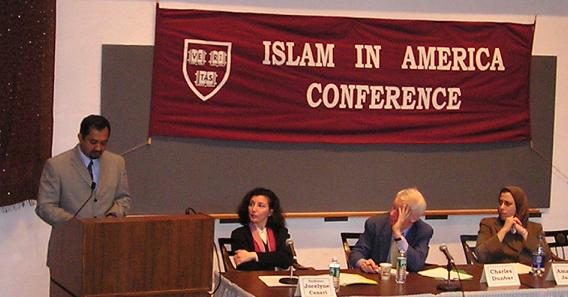
Speaking at the Islam in America Conference at Harvard University, March 06, 2004.
While the mood in the community is strongly anti-Bush, there are pockets of support for the current regime. Iraqis, particularly the Shiite community is very happy with the Bush administration and it will break ranks to support George W. Bush. The Shiites of South Asia see the invasion of Iraq as a just war against oppression. They will not only vote for Bush but will also contribute heavily to his war chest.
Finally politically conservative Muslims will come out in support of Bush. There are individual Muslims like Mori Husseini, CEO of ICI Homes who have become rangers (those who raise more than $200,000). Dr. Malik Hasan who told the New York Times that he “adores the President’s accomplishments” is a pioneer (raised over $100,000) and there are many more like them. There is a diversity of political opinions within the American Muslim community which will ensure that in spite of strong anti-Bush sentiment, the President will get some support either for his pro-democracy rhetoric overseas or for his social conservatism at home.
The American Muslim Task Force on Civil Rights and Elections 2004, an official umbrella organization of many American Muslim Organizations, has made Civil rights its main concern, they call their strategy “Civil Rights Plus.” They have identified American Muslim concerns as (1) Civil Rights, (2) domestic issues and general welfare and (3) Global peace with justice, war prevention and US relations with the Muslim World. This group is essentially the same group that under the name American Muslim Political Coordination Committee endorsed George W. Bush and, according to them, delivered 78% of American Muslim votes to him in 2000.
Dr. Aslam Abdullah of the Muslim Electorate’s Council of America (not a member of the taskforce) reports that a national study conducted by his organization reveals that there are 2.7 to 3.0 million potential Muslim voters today, but only 60% are registered reducing the possible number of votes to 1.6-1.8 million. Even if there is a high turnout of Muslims in November 2004, we are looking at about 1-1.25 million votes. This can be a significant number in a close election and American Muslims could play a pivotal role.
Can American Muslims really make a difference in 2004? If George Bush does lose by a million votes in 2004, then can American Muslims actually claim that they made the difference? Will it then teach American politicians not to mess with Muslim civil rights and Iraq? American Muslims hope that they can make a difference and make a point.
In the elections of 2000 the community felt that its most important goal was to announce that it was willing to participate in mainstream politics and that it was a force to reckon with. Voting as block, was therefore of great strategic importance to American Muslims then. But now things have changed. American politicians fully understand and recognize the strengths and limits of the community.
If American Muslims played the block vote politics again by endorsing the democratic candidate the potential gains through a democratic victory needs to be balanced against the dangers of another Bush victory. What the Democrats are willing to do to restore civil rights in America and reign in American military; they will do even if American Muslims do not vote for them. But if American Muslims endorse Kerry and Bush wins, then we will find out if the Republicans bear grudges and how far they are willing to go to teach a lesson to those who try to teach them lessons.
My advice to American Muslims is to stop having an instrumental relationship with the American system. It is time the community went way beyond one or two defining issues and started integrating with the challenges that America faces at large. We must allow our community members to find causes that they care for and let them vote their conscience. Voting blocks are antithetical to the spirit of democracy; they involve an undemocratic imposition of agenda defined by the elite on all members of the community. If American Muslims must find an authentic expression to their citizenship, then they must follow their conscience and vote for a better America based on self-interest and personal-judgment.