Previous Story
Mosques with Foreign Flags: Islam in America and Germany
Posted On Jun 09 2006
Comment: 0
This article has been published in the Khaleej Times [06.02.06, UAE], AltMuslim [06.01.06, USA], Alarab Online [06.01.06, UK], the Daily Times[06.05.06, Pakistan], The News Journal [06.05.06, USA], The American Muslim [06.05.06, USA], Naseeb Vibes [06.05.06, USA], Al Ahram [Egypt, June 15-21, 2006] and Pakistan Link [06.16.06].
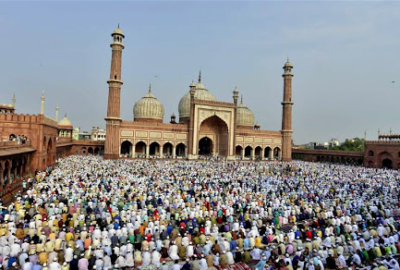
Berlin May 23, 2006. We entered the mosque through a large iron gate closely watched by a score of Turkish men. Unlike most architecturally interesting buildings in Berlin which are open and easily accessible, this mosque which is both majestic and grand, is surrounded by a high wall and is accessible only through iron gates. I was in Berlin for a conference organized by the American Institute for Contemporary German Studies and one of their scholars and a Berlin Parliamentarian kindly volunteered to show me around Berlin.
As we approached the grand mosque, the Berlin Parliamentarian remarked, “notice the Turkish flag on the mosque, do you see a German flag anywhere?”
The daylong conference in Berlin was about comparing the experiences of Germany and the US in integrating their Muslim minorities. Throughout the day, scholars from both sides of the Atlantic struggled with political and philosophical issues involved in the absorption of large number of minorities whose political and cultural values may be at odds with those of the host nations.
While Muslim scholars argued for more openness, more religious and racial tolerance and equal treatment of all religious communities, others called for more assimilation and insisted that immigrants must make the effort to learn local languages and adapt to the mainstream political and cultural norms.
As I looked at the mosque with its Turkish flag flying proudly, the high walls, the iron gates and the stoic faces, I suddenly realized that this was not a mosque, this was a sort of embassy, a foreign enclave, an extention of Turkish sovereignty in the heart of Germany. In the U.S. one may occasionally find a US flag in a mosque, but never a flag of a foreign country. The only mosque that has foreign flags is the Islamic Center in Washington DC which was established by diplomats from Muslim countries.
I sympathized with the Berlin Parliamentarian’s obvious displeasure with the Turkish flag. Turkish nationalism is particularly irritating. Several years ago I ran into a large contingent of Turks in the Holiest of Muslim Mosques in Mecca while circumambulating the Kaaba. They were wearing tiny Turkish flags on their shirt collars. I found this display of nationalism even in the House of God deeply offensive. Islam is a strictly monotheistic religion and nationalism in its extreme form begins to subvert the very idea of One God. Perhaps these Turks did not know that God is blind to nationality, ethnicity and race.
With Islamophobia on the rise in most western countries, grand displays of Islamic religiosity – the mosque is indeed fabulous – combined with overt, in your face displays of allegiance to foreign nations can only be described as spectacularly stupid.
Both Muslims and non-Muslims are actively demanding the elimination of barriers between western mainstream and Muslim Diasporas. While Muslims are insisting that host societies accommodate, recognize and respect all the differences that they bring, Non-Muslims – usually the dominant white Judeo-Christians – are demanding that Muslims moderate these differences. In Germany the focus is on learning the German language and the incorporation of Islam as a German institution. In the U.S. the challenges are more related to real or perceived sympathy of American Muslims for anti-Americanism in the Middle East.
Muslim immigrants bring three significant challenges to Western societies – cultural differences, religious differences and political differences. In the U.S. the first two challenges are easily manageable. Most Americans believe in the United States as a multicultural society and deeply value religious pluralism. Unlike Europe where the elite talk a lot about secularism but the State actually incorporates religion, America does practice separation of church and State.
In the U.S. the government is neither involved nor interested in how Islam is institutionalized or managed by Muslims, where as in Germany the state not only teaches religion in school but also has religious clergy on government payroll. This becomes particularly problematic since Germany finances both Christianity and Judaism but does not even recognize Islam.
In the U.S. most people respect and even value cultural differences, jealously guard religious freedom and consequently practice religious pluralism at all levels of society. Primarily because most American’s are from somewhere else, the fact that Muslims are also from elsewhere is not a big issue.
American identity is open, flexible and continuously evolving. American citizenship is also easily acquired and hence becoming American in law and spirit faces less cultural and political barriers. Additionally the “American dream” is a powerful positive that all immigrants aspire towards and often achieve. When traveling overseas, I frequently testify that coming to America for me was like joining the marines – in America one can “be all you can be”.
At present the key barrier to the mainstreaming of Islam in America is the relations between the US-and the Islamic World.
Germany has a long way to go. Even though it does not have foreign policy problems like the U.S., it has several domestic policy issues. First Germany must recognize Islam. Germany has been for decades a multi-ethnic society but very few Germans imagine Germany as a multicultural society. German intellectuals brag a lot about being secular, well how about secularizing the German State and dumping Christianity and Judaism from the national budget.
German identity is rooted in the past and is culturally tied to race, and ethnicity. Becoming German is very difficult even for those who are born in Germany; speak German better than most natives but happen to look like me rather than Boris Becker.
German intellectuals must begin to imagine a Germany as a political community that is a composite of values, rather than a nation-state based on a specific ethnicity. In the age of globalization, narrowly defined identities are untenable. Germany as an integral part of the emerging global society must define itself in terms of global values that are sensitive to cultural, racial and religious differences and become a role model for other European nations like Ireland and Portugal that will soon face similar problems.
Muslims who live as minorities in the west or anywhere else, must understand that their demand for tolerance for religious and cultural differences is a just cause. But they must align their political and economic interests with those of their neighbors [whose acceptance they seek] and not with those who live in foreign lands.
There is room for Islam in America and Germany. We can and we will build bigger and more spectacular mosques in the West, but there is no place for Saudi flags, or Turkish or Pakistani flags in Western mosques. They have their embassies and that is enough. They should not be allowed to use our mosques.