Previous Story
Struggling for the Souls of Islamic schools
Posted On Jul 03 2005
Comment: 0
This article was commissioned by and published in the San Jose Mercury News [07.03.2005]
In the weeks since the FBI announced a terrorism probe and began making arrests in Lodi, precious little has become clear. Among the many open questions is whether authorities still believe there might be an Al-Qaida “cell” in that town south of Sacramento and whether three of the men detained will ever be accused of anything more serious than immigration violations — even though their names have now become linked with terror. Only two of the five men caught up in the investigation, a father and his 22-year-old son, have so far been accused of terrorism-related charges; they were indicted for allegedly lying to the FBI about the son attending a terrorist training camp in Pakistan.
Still, from what little we know so far, it appears that a subtext in this drama that has unfolded before the national media is a disagreement over who was going to control a planned Lodi religious school for young Muslims. One of the men detained on immigration charges is an educator from Pakistan who had been trying to launch that school. On one side of the struggle is a multi-ethnic group that includes Fijians from East Palo Alto. On the other side is a group, mainly of Pakistani-Americans, that some in the community have described as more old-fashioned.
Such conflicts have become increasingly common, with Islamic schools emerging as key battlegrounds in the struggle between moderate and conservative Muslims in the United States. The fights also have become more pitched since the Sept. 11 terrorist attacks, as Muslims have increasingly grappled with how to meld their American and religious identities.
For years, the object of Islamic education in America was to resist cultural assimilation while encouraging political and economic participation in the mainstream. Muslims want the power and wealth that America can offer, but they wish to eschew its socially liberal culture, particularly its sexual mores. For traditional or conservative Muslims, Islamic full-time and Sunday schools proved a popular way to try to keep their children from turning “too American.”
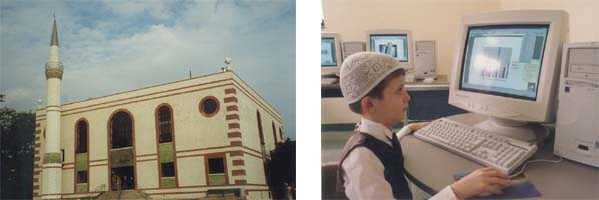
Images from the Miraj Islamic School in Staten Island, New York
But since the mid-1990s, a growing number of parents and reformers have begun to believe that some schools are creating their own problems. These critics have worried that the schools are perpetuating traditions such as unequal status for women that don’t work well in a multicultural, democratic society and, in the worst cases, that the schools are alienating children from the society in which they must function.
While it remains unclear what happened in Lodi, supporters of the detained educator, Mohammad Adil Khan, have been quoted in the media saying he was committed to creating a “moderate” school, reflecting the democratic style he developed as the former imam of a Lodi mosque. (That style was a departure from that of the conservative madrasah, or religious school, run by Khan’s father in Karachi, Pakistan.) Khan’s more “American” approach at the mosque caused a rift with conservative members, who sued the board of Khan’s Farooqia Islamic Center, alleging, among other things, that Khan had overstayed his visa.
Muslim migration
Muslims began to migrate in large numbers to the United States in 1965, after immigration laws were reformed. The majority of the immigrants — principally South Asians and Arabs — were well-educated, have professional degrees and came to the United States mainly for economic opportunity. Their early material success enabled the emergence of a highly ambitious leadership that began to have grand visions for the American Muslim community.
To achieve their goals — which included drumming up more support for Muslim causes worldwide — it was necessary to preserve the Islamic identity of the next generation and unite different ethnic groups so the American Muslim community would speak with one voice. A network of Islamic schools was considered key to both uniting and educating the community.
The problem was that there were (and still are) few qualified Islamic-studies teachers in the United States. So, the new American Muslim communities came up with short-term fixes. Many imported imams and other religious leaders from Muslim countries to teach their children. (About 5 percent of roughly 2 million American Muslim children attend full-time Islamic schools, but many more attend Sunday schools.) Some families also sent their children to live for a time with relatives “back home,” where they could imbibe the cultural norms of their parents’ homelands and attain a basic Islamic education.
It appears that Hamid Hayat, the indicted 22-year-old, may well have been one of those youths. News reports have said his father told FBI agents that Hamid Hayat became interested in attending a jihadist training camp when he was a teenager living in Pakistan and that he was influenced partly by his education at a madrasah run by his grandfather in Rawalpindi.
If true, that would make his case unusual. It is unlikely that most Muslim teens sent abroad would attend madrasahs; those schools generally focus on religious rather than academic studies and would hardly prepare them for the types of careers the many affluent American Muslims envision for their children. (Most of the more than 75,000 madrasahs in India, Pakistan and Bangladesh, in fact, serve as orphanages for underprivileged children. There are, however, some madrasahs in Pakistan established to produce mujahedeen to fight the Soviets in Afghanistan that have been reinvented to train recruits for Al-Qaida and the Taliban.)
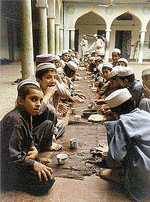
Madrassahs are orphanages too
Also with the growth of Islamic centers and schools in North America — there are roughly 3,000 centers and 1,200 Islamic schools, about 400 of them full-time — very few Muslims feel the need to send their children abroad to learn the basics of Islam. Young American Muslims now travel more to improve their Arabic or to taste the cultural flavors of the traditional Muslim world.
Importing teachers
What is far more common than Hayat’s experience is young Muslims studying here under imported imams who are often more conservative — and anti-American — than their congregations.
Initially the idea of importing imams was limited to inviting huffaz, people who had memorized the Koran, to lead special prayers during Ramadan. Gradually, communities started inviting these people to do more at growing Islamic centers, including teaching. These individuals were imported through R visas for religious workers.
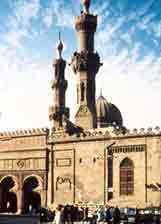
Al Azhar the oldest of them all
The imams from abroad have been both a boon and a curse. They did provide basic Islamic education for children and also helped create continuity with religious practices from their families’ home countries. But although these imams migrated to America physically, most have not done so in a spiritual and intellectual sense. They preach that women should maintain traditional roles and generally warn Muslims from adapting their faith to local conditions. Until recently they maintained that democracy was an un-Islamic idea and tried to prevent Muslims from engaging in mainstream society. They also teach intolerance of other faiths and encourage political anti-Americanism.
Some lay leaders, of course, share these views, especially those with strong ties to such groups as Jamaat-e-Islami in Pakistan and India and the Muslim Brotherhood in the Arab world, which seek to create Islamic nations. These leaders not only continue to import such imams, but they also protect their positions once those imams are here.
Seeking to modernize
But in recent years, those lay leaders are being met with increasing opposition from those who say it is crucial to modernize Islam, synthesizing it with democratic liberalism. Because that kind of evolution can take decades, Muslim reformers have come up with stopgap arrangements to minimize the dangers from imported imams.
The first has been the democratization of the Friday sermon and Islamic schools. More mosques have begun to invite laypersons to give Friday sermons. Because these individuals focus on local issues and speak to the day-to-day life of ordinary American Muslims, they often become popular and can keep the imported imams at bay. Some Islamic schools, meanwhile, are working to hire U.S.-trained teachers for both religious and non-religious subjects.
The second change has been the emergence of an incipient but growing attempt to re-educate and re-orient imams. The Leadership Center at the Islamic Society of North America, for example, gives short but frequent seminars and workshops on the need to pay attention to the American context.
There is also a small and embryonic effort to develop indigenous imams. Two institutions, the Hartford Seminary in Connecticut and the Graduate School of Islamic and Social Sciences in Virginia, offer programs in imamate and Islamic studies. So far, however, most of their graduates have become chaplains with the armed forces and in prisons.
In the end, the goal of liberal American Muslim leaders is to combine what is, in their minds, the best of their two worlds. They’d like to preserve their Islamic identity while democratizing Islam, and use their beliefs to change American society and foreign policy. And the key to achieving those goals, they believe, is to create a network of quality Islamic schools from the elementary through university levels, modeled on Roman Catholic schools, that provide both academic and religious schooling.
Such schools will help keep Muslim teens, for instance, from what Muslims see as the worst of many American high schools: promiscuity, pregnancies, drug use and violence. But, if reformers prevail, the schools will do so without turning those young American Muslims against what is good in America.
Right now, that dream seems a long way off. Funding such schools has been generally woeful, and unlike in the Catholic Church, there is no bureaucracy in place to standardize secular or religious curricula. But supporting the growth of American-trained imams and diminishing the role of old-world religious teachers is at least a start in creating a sophisticated system of Islamic education that may one day serve as a model for liberal Islamic education in the rest of the Muslim world.