Previous Story
Pope John Paul II: He helped Build Interfaith Bridge
Posted On Apr 06 2005
Comment: 0
This article was first published in the USA Today, April 6th, 2005.
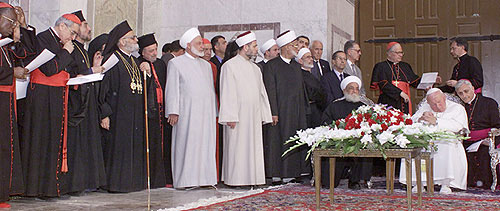
Syria’s Grand Mufti Sheikh Ahmad Kuftaro, seated left, meets Pope John Paul II
at the Umayyad Mosque compound in old Damascus
Four years ago, Pope John Paul II appeared at one of the oldest mosques in the Islamic world, the Ummayad Mosque in Damascus, Syria. It is deeply cherished by Muslims and Christians because it is believed to be the tomb of Prophet Yahya (John the Baptist to Christians). During the visit, he said: “It is my ardent hope that Muslim and Christian religious leaders and teachers will present our two great religious communities as communities in respectful dialogue, never more as communities in conflict.”
For centuries, Muslims have felt alienated by Christianity. Though Muslims recognize Christianity as a revealed religion of God, Christian denominations have rejected Islam as heresy and waged holy wars against it. Despite theological disagreements with Islam, Pope John Paul II departed from this historical practice. He always considered Muslims as a fellow spiritual community deserving of respect and admiration.
Islam and Christianity share a majority of their beliefs. The principle value of the unity of divinity, the prophets, Jesus and Mary, Jerusalem and the promise of life after life are all common to both faiths. The Koran, the book that Muslims believe is the direct revelations from God, acknowledges Judaism and Christianity as precursors and early forms of Islam.
Today, through the efforts of John Paul II as a pioneer in interfaith bridge-building, Muslims, too, feel as though Catholicism has started to reciprocate and recognize Islam and Muslims as partners in spirituality.
On the death of this pope, Muslims all over the world are expressing their sorrow and solidarity with the Catholic community. Muslims see John Paul II as a dear friend who reached out to us repeatedly. He was not only our religious partner in worshipping the one God, but he also was a political ally who frequently spoke up for the rights of all peoples, including Muslims.
He often called for peace in the Middle East and for restoration of rights and dignity to the Palestinians. He was against the war in Iraq, and he believed ardently that Muslims and Christians, working together, could bring both God and peace to our world.
In a world despiritualized by materialism, secular fundamentalism and religious extremism; ravaged by war, greed and violence; and disenchanted by ideologies and false religions; he was a champion of morality, moderation and peace.
The world has truly lost a global elder.