Previous Story
Islam in the West: The Threat of Internal Extremism
Posted On Feb 22 2005
Comment: 0
This article was published in The Q-News [Feb. 2005 – UK], The Muslimwakeup.com [Feb 18, 2005 – USA],AlMuslim.com [Feb. 17, 2005 – USA], Iqra [Feb 18, 2005 – Canada], Closer [Feb 21, 2005 – Netherlands]. Research Institutions such as The Brookings Institution, Zogby International and ISPU also carry it on their websites. Shorter versions have appeared in Beliefnet.com [March 9th, 2005 – USA] and Islamic Horizons [May, 2005 – USA].
 The tension between the US and the Muslim World has been steadily escalating with both sides resorting to steps that undermine the prospects for more peaceful and cooperative US-Muslim relations. Western Muslims, in America and Europe, suffer directly as a result of this escalation. They are being targeted as a potential fifth column and though they have responded admirably to face the new challenges, their circumstances continue to deteriorate. The presence of a persistent anti-western extremism within a small minority of Western Muslims exacerbates the plight of Western Muslims and undermines all their efforts to improve relations with the broader Western communities and allay fears that Islam in the West is a threat to democracy and security.
The US led invasion of Iraq and the subsequent chaos, death and destruction in Iraq, compounded by the inability of 1700 US experts to find any trace of WMDs in two years of systematic searching [the stated reason for the invasion] has contributed to an unprecedented amount of anger, frustration, resentment and anti-American feelings among Muslims everywhere. According to several international polls conducted by the PEW forum and Zogby International, public opinion of the US across the Muslim World (and elsewhere in the world) has plummeted and is at its lowest ever.
The Bush administration’s tactics of keeping the fear, anger and resentment triggered by the 9/11 catastrophe alive in order to advance the conservative agenda combined with frustration of American goals in Iraq and a sense of being at war with Muslim extremism has made many Americans increasingly hostile towards Islam and Muslims. Polls conducted in the US suggest that while 38% Americans hold very negative views about Islam and Muslims, only 2% have anything nice to say about them [survey conducted by CAIR Survey, November 2004] and over 44% of Americans are willing to deprive Muslims freedoms and rights available to other Americans [A survey by Cornell University, December 2004].
The war on terror and its attendant consequences has created extremely difficult circumstances for American Muslims in particular and Western Muslim in general. The changing political and legal environment in Western countries across the board has undermined the quality of life of Western Muslims. Many face discrimination in the work place, are victims of racial and religious profiling, businesses are failing, international travel has become difficult and risky and Islamic institutions, and particularly mosques and Islamic charities face harassment and unnecessary scrutiny.
The world has never been more interdependent and the plight of Western Muslims is illustrative of how global integration is now a palpable reality. The murder of a Dutch film producer, Theo Van Gogh, allegedly by a disenchanted Dutch Muslim [Mohammed Bouyeri, 26], the denial of a visa to the US for a Swiss Muslim scholar, Tariq Ramadan, or the humiliating deportation of a British Muslim, Yusuf Islam, from the US immediately on arrival are all front page news all over the world. Not only do these episodes draw widespread attention from the media, they feed upon and fuel the new crisis in Western Civilization – “Islam in the West”.
When a Dutch animal rights activist, Volkert van der Graaf, murdered a Dutch politician, Pim Fortuyn in 2002, it did not raise questions about the compatibility of the philosophy of rights and the West. But when a Dutch Muslim murders a Dutch film producer, it raises profound questions not just about Islam’s compatibility with modernity and democracy but also about the ability of Western Muslims to live in a democratic society. Even though such outrageous episodes are extremely rare, the fear of Islam and the now embedded antipathy towards Muslims, frequently surfaces in the western media, in popular discourse, in casual conversation, in parliamentary discussions and in new legislations.
As long as relations between Western societies and the Muslim World remain less than cordial, Western Muslims face the reality of Islamopheobia and as a result they will remain second-class citizens, constantly watched, regularly demonized, systematically marginalized, feared, despised and portrayed as a potential fifth column. Defending the innocence of Western Muslims, and speaking about tolerance and Islamic teachings on peace and violence, has become the most important communal activity of western Muslims.
The Challenge for Western Muslims today is existential. If things get worse what will happen to them? Some fear the rhetoric and recommendations of Islamopheobic political commentators who exaggerate and exacerbate the situation, questioning the patriotism of Muslim communities in the West and even raising the example of the internment of Americans of Japanese origin during World War II. Will the West create another “Israel” to solve the problem of the new Jews of the West? The fact that there are nearly 20-30 million Muslims in the West makes such drastic solutions impossible. Those who are bewildered that we are even considering this possibility must remember not only what happened to Japanese Americans but also what happened to Muslims in Spain who disappeared after ruling Spain for 700 years.
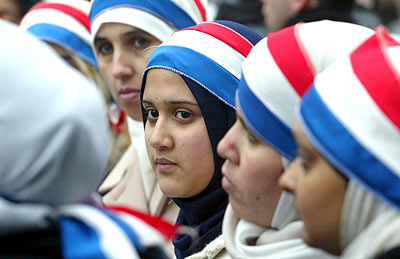
There are three routes available to Western nations with regards to their Muslim populations. They are marginalization, assimilation and accommodation. The first implies dis-empowering the community, reducing its influence and its rights and making its presence insignificant. The Bush administration has adopted this policy since 9/11. The second strategy is to reform Islam and Muslims, secularize them to such an extent that the difference does not make a difference. The French have embarked on this strategy and face a lot of resistance. This strategy causes disharmony and divisions within society and undermines democracy. Accommodation, a strategy that was adopted by the US before 9/11, by the UK, Canada and Netherlands is for Muslims the best option.
But in order to push Western nations to adopt the strategy of accommodation and resist the political pressure from xenophobic right-wingers to do otherwise, Western Muslims will have to manage their politics with foresight, prudence, and patience.
Dangers for Western Muslims
There are three potential dangers that Western Muslims face. Increased anti-western terrorism in the Muslim World which fuels Islamopheobia, enhances the political influence of Western anti-Muslim extremists and enables the institutionalization of legislation designed to undermine the influence of Muslims. The bush administration’s foreign policy that is geared towards the projection of American power and reassertion of American hegemony in the Middle East is another threat to Western Muslims. Aggressive American unilateralism triggers events and actions that ultimately undermine the security and well being of Western Muslims. The third danger to Western Muslim future is homegrown extremism.
While western Muslims at the moment can do little to reduce the first two dangers beyond engaging in dialogues – political and religious – at various levels, they can and must play an aggressive and decisive role in eliminating internal extremism that resonates with extremism in the Muslim World. Extremist discourse, actions and postures by a small minority of Western Muslims not only undermines the efforts of the vast majority to improve Western-Islamic relations, they also provide concrete evidence of the most egregious stereotypes of Islam and Muslims.
Western Muslim community leaders, activists and scholars must condemn and reject any and all forms of extremist rhetoric coming from Jumma Khutbas, public statements on TV and other media and from Muslim publications themselves. Care must be taken to not only moderate Muslim public discourse but also Muslim-Muslim discourse in order to ensure that extremism and vehement anti-Westernism do not take root in the community. Islam and Muslims in the West can be critical of the West and Western ideals but cannot and must not be anti-West. The critical distinction between being opposed to American foreign policy in the Muslim World and being anti-American must be maintained.
The Threat of Internal Extremism
While a vast majority of Western Muslims have the same basic desires as many others – material well being, cultural acceptance and the opportunity to practice their faith without social and political intimidation some of them however wish to use their geographic location as an asset in their war against the perceived enemies of Islam. The argument made by some that radical Islam is well deeply embedded in the West and the community western Muslims hides in its bosom many secret sleeper terrorist cells is patently false and such claims must be seen as racist and religiously bigoted. No community has been so closely scrutinized as Muslims in America and no widespread threat has been uncovered. The 9/11 Commission fully exonerated the community of any connection to terrorism.
Nevertheless in every Muslim community there is a small group of individuals angry with the West and fearing that Islam is being destroyed. In their ignorance and anger they say and do counter-productive and dangerous things. The continuous barrage of images of Arab and Muslim humiliation and defeats from Iraq and Palestine make it difficult for even those most pacific to remain calm. Occasionally people lose control and say things that hurt them as well as the community.
Most people in the West are sensible and recognize isolated episodes of violence or intemperate rants as isolated. However there are three issues on which a small minority of Western Muslims, continue to alienate Western populations from Islam and Muslims.
(1) Justifying Suicide Bombing: The images of the attacks of September 11th and the many victims of suicide bombings in Iraq and Israel have become etched on the Western psyche. Suicide bombing has become an epitome, a metaphor for of all that is evil in this world and all that is terrible about Islam and Muslims. Even though most Muslims everywhere – with notable exceptions of course – condemn suicide bombing as unIslamic and when targeting civilians as an abhorrent form of terrorism, some Muslims continue to utilize the freedom of speech available in the West to claim that suicide bombing is a noble and Islamically justifiable defense strategy. These individuals who defend and support suicide bombing [sometimes even when targeting civilians] succeed only in branding Islam as a barbaric religion that inspires violence. They also belie the majority of Western Muslims who condemn it and make it look as if they are dissimulating and lying. This promotes the canard that western Muslims are all secretly supporters of terrorism and that Islam indeed teaches violence. Those who continue to hem and haw on the issue of condemning suicide bombings by invoking “complex realities” and resorting to moral relativism work, intentionally or unconsciously, with Muslim radicals in undermining the fundamental moderation of Islamic teachings.
(2) Equating the war on Terror to the war on Islam: Some radical Muslim commentators have been insisting that the war on terror is actually a war on Islam. Unfortunately the history of American foreign policy and the US’ recent actions in the Muslim World have convinced many Muslims that the US is at war with Islam. Ironically these radical commentators themselves equate Islam with terror when they translate the war on terror as war on Islam. For Western Muslims this is an unacceptable interpretation of what is happening. First of all it is not true. Islam continues to thrive in the West even today. The prominent role played by American Muslims in the Presidential elections of 2004 is clear proof that in spite of growing Islamopheobia and the Patriot Act American Muslims still remain a vibrant force and far from being snuffed out. Yes, they are targeted and profiled because of the actions and discourses of radical Muslims, but most of them will testify that the war on terror is not a war on Islam. In Europe the presence of Muslims has transformed Europe’s foreign policy, its relations with the US and its posture with regards to the Arab-Israeli conflict. Today Europe seeks to balance US’ support for Israel. Muslim commentators who continue to propagate these claims are trying to insert a wedge between Western Muslims and their homelands. They wish to use Western Muslims as a weapon to subvert the West from within, but in the process sacrificing the community. Those who insist that the West is at war with Islam do a grave disservice to Western Muslims and to undermine the prospects of future good relations between the West and the Islamic World.
(3) Demonization of the West and Democracy: The third theme in the radical Muslim discourse includes a rhetorical demonization of the West as evil and democracy as hypocrisy. In a curious way the very existence of this “free radical discourse” is indicative of how strong democracy is across the board in western countries. But this constant demonization of the West (America and Europe), ridicule of their values, icons, their religious beliefs, their secular beliefs and cultural practices may very well lead to the elimination of free speech and the diminishing of democracy. As far as Western Muslims are concerned, the 19 Muslims who attacked the US on 9/11 have caused them untold misery; they cannot allow it to be amplified through irresponsible statements from within their own communities.
The community must get tough on radical discourse
We recommend that Western Muslims become more organized and aggressive in marginalizing and condemning voices that justify violence, incite hatred and practice demonization of the other. How can community members and leaders fight bigots in the mainstream community and the rising Islamopheobia if some within their own ranks mirror the same fear, ignorance and prejudice? When some one from the community makes a radical statement, community leaders must immediately condemn it and demand a retraction and an apology before anyone else does it. Once radicals realize that the community will not tolerate their extremism, and will take lead in condemning them, they will fade away. The struggle for acceptance of Islam and Muslims in the West cannot be divorced from the acceptance of the West within its Muslim communities.