Previous Story
Iraqi Elections: Have the Iraqis voted for a Dictatorship of ayatollah Al-Sistani?
Posted On Feb 14 2005
Comment: 0
This article was published by The Globalist [February 14-21, 2005], The Daily Times [02.12.2004] and many other.
The Bush administration is under the false impression that the elections in Iraq herald the era of democracy in Iraq and thus justify the Bush preemption doctrine. What it seems they cannot see is that the US has just facilitated a major transfer of power in the Arab World – from Sunnis to Shiites. Thanks to the US the Arab Shites will now control Baghdad – the jewel in the Islamic crown – after a millennium. They did not rule over Baghdad even under the glorious Fatimid Dynasty (909-1171), a Shiite dynasty that ruled over Egypt, North Africa and Syria nearly a thousand years ago but had a tenuous hold briefly under the Buwayhid tribal confederation from 945-1055 when the Turkic Seljuks invaded and captured Baghdad with the help of the Abbasids.
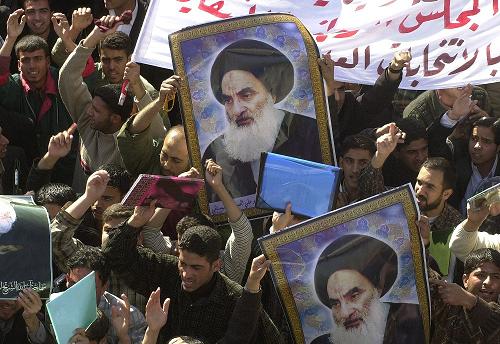
Very few men on the planet command such loyalty and devotion as Ayatollah Al-Sistani
The Iraqi elections according to most analysts are a triumph for the Bush administration’s Iraq policy, since an estimated 60% of the potential 14 million voters voted on January 30, 2005.
The large turnout, in spite of escalated violence by the insurgency which took hundreds of lives in the run up and 44 lives on the day of the elections itself, is being interpreted as indicative of the Iraqi people’s desire for democracy and free society. Though the elections were marred by violence and the boycott by the Sunni minority, the very fact of that a “free election’ was held in Iraq in more than half a century is being touted as a significant step towards democracy.
First of all talking about “free” elections in the context of Iraq is stretching the truth, sort of like the claims that Iraq had large stockpiles of WMDs and was on the verge of attacking the US and Israel in 2001. Iraq is currently under occupation by foreign powers that have over 170,000 troops [150,000 US and other Coalition forces] in the country. There is an extremely violent and vigorous on going insurgency in the country that puts a cloud on the free-ness of the elections. The leadership of the Sunni community who constituted about 20% of the population had announced a boycott of the elections and the extraordinarily low turnout in Sunni areas [due to the boycott and the insurgency] clearly undermines the legitimacy of this election. It is incorrect to call this anything but a highly problematic political exercise.
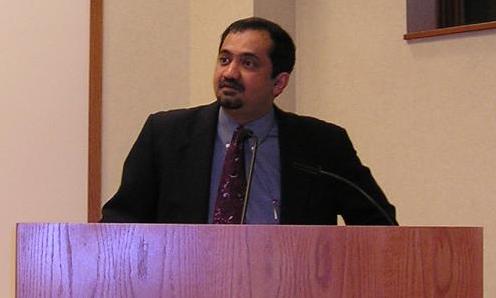
“The Anatomy of Iraqi Elections” | Lecture at Sienna Heights University 02.08.2005.
We must not forget that until Ayatollah Sistani insisted on early nationwide elections to the US was opposed to such an election and was determined to form a government based on local community representatives handpicked by the US. It was only after the US agreed to a nationwide elections to install a transitional government that will write the new constitution did the Shiite community cooperate with the occupation forces and the incipient Shiite insurgency led primarily by Moqtada Sadr in Najaf and other places fizzled out at the intervention of Ayatollah Sistani who expedited his return from Britain, on August 25, 2004, to placate the growing anger in Iraqi Shiites.
Ayatollah Sistani is manipulating the US occupation and the lack of a post conquest plan at the Pentagon to orchestrate a Shiite revolution. It is possible that when the history of the world is rewritten, Ali Sistani will be considered as the most Machiavellian and the most astute political strategist ever. Ayatollah Sistani has seen the future. A democratic Iraq essentially will be a Shii Iraq run by his surrogates who will win elections with his blessings, will rule on his behalf as members of a democratic government. In principle and on record Ayatollah Sistani does not believe in theocracy, that is rule by the clerics. However his entire conduct since the US invasion of Iraq is clearly suggests that he has no qualms about controlling, directing and even manipulating politics from behind the scenes.
Ayotollah Sistani and his clerical brigade will not participate in the government as his friends and colleagues do in Iran. They will delegate the menial aspects of governance to the secular elected leaders but the key elements such as writing the constitution, developing the new legal codes, determining the role of Islam in the polity [especially which interpretations of Islam] and the philosophical foundations of foreign policy, particularly relations with the Arab world and with the West, will be determined by the grand ayatollah and his coterie of clerics.
The elections should not be read as indicative of a desperate desire for democracy by Iraqis who came out to vote. It should be seen as a manifestation of power that Ali Sistani wields on the Shiite population of Iraq. It was his decree that it was a religious obligation of Shiite Muslims to vote that is primarily responsible for the huge turnout. The Shiites by and large recognize that the US is presenting them with a historic opportunity and if they exercised discipline, patience and followed the Ayotallah, they would rule Iraq. They will not only come to power but their principle opponents will be quashed by the US itself. Najaf, the holy center for Shiites will become like Mecca under a Shiite ruled Iraq and another era of glory would begin in the history of Shiite Islam.
While the Sunnis of Iraq are fighting a violent Jihad against US occupation and opposing democratization to prevent Shiite hegemony over Iraq, the Shiites are engaged in their own silent Jihad. It is quite possible that the US led invasion of Iraq has replaced an overt and brutal dictatorship of Saddam Hussein with a covert and subtle dictatorship by Marja-e-Taqleed [Role Model for Emulation] Grand Ayatollah Ali Sistani who is the highest-ranking Shiite authority on the planet.