Previous Story
Epistemological Hijab
Posted On May 11 2005
Comment: 0
This article was first published by Islam21 [issue 37, Sept. 2004] and then by their Friday Notes publication. Arabic translation is by the staff of Islam21. The article has since be republished by Altmuslim.com [April 20, 2005], Islamic Research Foundation, The Globalist, Naseeb Vibes [April 18, 2005], Pakistan Link [April 29, 2005], The Daily Times [April 19th, 2005].
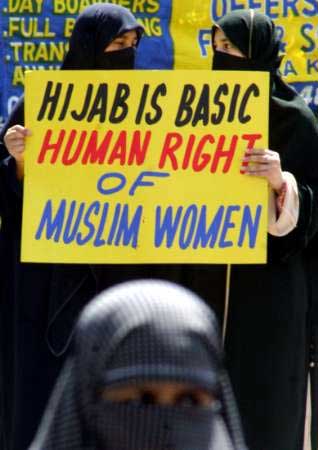 The issue of “Hijab”, its various implications and the politics surrounding it, has become a globally polarizing issue. Whether in France or in Turkey, between Muslims and others and between liberal Muslims and traditional Muslims, the Hijab has become a site for the cultural struggle between Islam and modernity and between contemporary and traditional interpretations of Islam.
The Hijab is to some a symbol of Islam’s ascendance in the world, while for others it is a reminder of the intransigent Muslim resistance to things that first emerge in the West – modernity, secularism, feminism, liberalism and globalism. For some Muslims in France, it is a symbol of their resistance to French cultural occupation over Arabs and Muslims in France. For Islamists in Turkey, it is an important means to preserving the Islamic heritage of Turkey from secular fundamentalism. For non-Muslim observers, it is often an introduction to an Islam that has misogynistic proclivities.
No matter what the perspective one employs, the fact remains that the Hijab is an instrument of segregation and containment.
The Hijab in its philosophical sense marks the Muslim woman for separation and for “different” treatment in all aspects of life; the most egregious being the moral differentiation it engenders. Muslims who claim that Hijab is an instrument that compels society to treat women in a special, even exalted way (in terms of security and respect) do not work to ensure that the society has special affirmative laws in place that will guarantee equal outcomes for women, since the Hijab ultimately undermines equal opportunity.
But the sartorial Hijab, and its attendant social practices of segregation, disenfranchisement and marginalization of women, is but a symptom of a more profound and civilizationally debilitating form of Hijab that is practiced by contemporary Muslim society. What is significant and must be confronted with vigor is the Epistemological Hijab that “good” Muslims insist on imposing on “good” Muslim women. The Epistemological Hijab is the traditional barrier that exists between women and Islamic sources. Women have played a marginal role in the interpretation of Islam and articulation of the laws and rules that are forced upon them. The Epistemological Hijab – the barrier between women and Islamic sources – has fundamentally rendered the articulation and enforcement of Islamic laws undemocratic. This undemocratic tradition privileges men and exploits women. Its reconstitution is important and more so now than before.
In the postcolonial era, a strange paradox has captivated the global Muslim community. The nearly hundred-year-old Islamic revivalist movement that is singularly responsible for the global significance of Islam, has been driven by lay intellectuals. Consider the following key figures of Islamic revival; Jamaluddin Afghani, Hassan Al Banna, Syed Qutb, Ali Shariata, Muhammad Iqbal, Abul A’la Maududi, Khurshid Ahmed, Malik Bin Nabi, Rashid Ghannoushi were all lay intellectuals, many educated in the West. Many of them were of course exposed to traditional Islamic sciences, but none of them was an Islamic jurist.
But for some inexplicable reason, the ascendant Islam today is highly legalistic and Shariah-obsessed. Islam in the mind of many Muslims is nothing but Shariah – what it really means in operational terms is that the beauty, the virtues and the meaning of Islam is confined to the rather mundane domain of medieval Islamic legalist discourse – Fiqh – which lacks the intellectual depth of Falsafa (Islamic philosophy), the aesthetics and the mystery of Kalam (Islamic theology) and the spirituality and charisma of Tasawwuf (Islamic mysticism).
We live today in an era of Islamic banking – Shariah-compliant transactions – and Halal hamburgers; we ponder over the legality of eating marshmellows, and deliberate over the propriety of women shaking hands with men. Mind you, all serious legal matters, such as for example state-military relations, international transactions, have very little input from Islam or Muslim jurists, since the Muslim world merely follows the conventions of Western/international laws. Islamic legalism is itself confined primarily to issues of personal matters only.
This peculiar legalism, which has colonized Islam and the Muslim conscience, is a product of the vulnerabilities of the Muslim man who has tried to cope with his own insecurities in a world dominated by other men. Muslim men today are not sovereign beings. Other men dominate their world. The only area where they exercise absolute sovereignty is over the tiny domain called Islamic law. Here they realize their manhood. They glorify themselves, grant themselves exotic privileges and assure themselves of their power by exercising it on their women. This exercise of power is realized by complete exclusion of women from participating in the process of deriving and interpreting Islamic rulings from the sources.
There is perhaps no other legal tradition extant today where one has no say in the articulation of laws that govern one’s entire life. Muslim women have very little if no role in the process of developing Islamic Fiqh. Even historically, men and men alone have developed all the Madhahib – legal schools, and legal principles, even those that deal with the most private aspects of female existence. Thus Islamic legalism has descended as a shroud on the Muslim women, covering her very essence from the world, disconnecting her from her own reality, depriving her of the right to understand and interpret her own being and disabling her from being able to navigate her own life. Islamic legalism fundamentality veils the Muslim woman’s consciousness. Frankly it dehumanizes women.
Muslims scholars and philosophers of every tradition maintain that the essence of humanity is either our moral compass or our reason or both. By preventing Muslim women from exercising their reason to derive the moral laws by which they live, Islamic legalism denies them the most human of all exercises using our reason to become capable of making moral judgments. In a way Islamic legalism steals women’s God given humanity from them.
Islamists are fond of repeating that in Islam, God is sovereign since He and He alone has the right to make laws. Unfortunately, this is a very superficial understanding of Islam and fails to recognize the distinction between revealed principles (Wahy), human product (Fiqh). They obfuscate the distinctions between the two and call it law (Shariah). By insisting that the opinions and arguments of long dead medieval jurists are actually divine law, Islamists make jurists the God of Muslim women and introduce a new and oppressive partition/veil between the women and her real God. In some cultures this divine status of men over women is recognized since men are sometimes referred to as the “majazi khuda” (manifest God) of women.
If Muslim women wish to regain their humanity and gain an equal moral status with men, which is not denied to them in principle but only in practice [within Islamic society], they must tear the partition that separates them from their right to understand and interpret Islamic sources and act upon their own understanding.
They must tear asunder this Epistemological Hijab imposed by Islamic legalism that stands between them and their God. Until then all discussions about the cultural and physical will remain superficial and contained within the context of the masculine logic that currently exercises such supreme sovereignty over Islamic principles and its derivative laws.