Previous Story
Let the Elections be about the Future of the Free Society
Posted On Mar 21 2004
Comment: 0
The philosophical premise of my transition from an Indian Muslim to an American Muslim is my understanding of what America stood for.
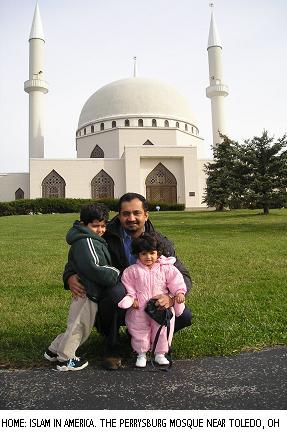 I believe that if being an American means believing in a free society — democracy, civil rights, free trade, free markets and freedom of religion — then even though I was born in India, I was born an American. The day I started thinking like this, that day I understood the fundamental relationship between freedom and humanity.
It is only in free societies that we can be all that we can be — just, moral, ethical, creative, conscientious and rich. Therefore when I came to America a dozen years ago, I took to it like a fish to water. I testify that, thanks to God and thanks to America, I am living the life of my dreams.
But lately I am beginning to feel a little disquiet. Are we entering an era when America may no longer be able to afford American values?
Honey, I shrunk Democracy!
Since September 11 we have experienced a steady shrinking of American democracy and economy. The USA Patriot Act and its attendant controversies are all too familiar. The problem is not just the act itself but the environment that facilitated such sweeping legislation that limits freedom. The acceptance of the act by a majority of Americans has heralded a new period in American history when security fears are rolling back hard-earned constitutional provisions that protect individual rights in America.
The act is indicative that Americans are so frightened of the Bin Ladens of this world, that they are ready to comprise their most sacred value — freedom and democracy. It is a matter of concern that when attacked we did rally behind the flag (literally displaying it every which way) and behind the president whose approval ratings reached great peaks, but not behind our constitutive values of freedom and democracy.
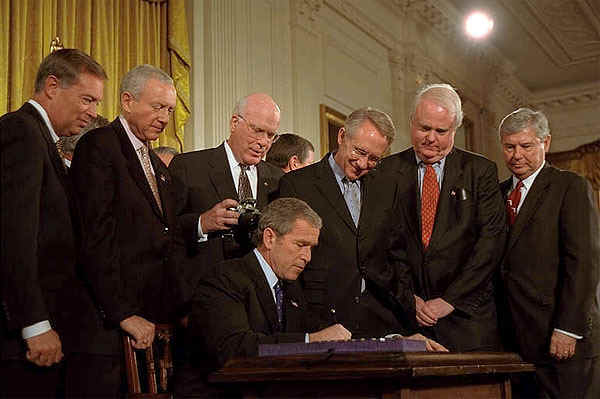
President George W. Bush signs the Patriot Act, Anti-Terrorism Legislation, in the East Room Oct. 26, 2001.
One would have thought that once the Americans had time to realize that the USA Patriot act had dealt a real blow to their values and maimed the constitution, we would use the coming election as a referendum to restore the full majesty of our constitution and its crown jewel — the Bill of Rights.
The possibility that the entire act will be repealed is minimal. At best one can hope that some of the most egregious provisions in the act that specifically violate due process will be repealed. The specter of anti-American terrorism continues to grow. Ironically it seems that terrorists and not American citizens will determine the health of American democracy. Has the fear of global terrorism forced us to accept lower democratic standards? Are we living in an era when democratic freedoms at home will always be determined by fears, real and imagined, of external enemies?
I do not think so. It is time for us to have a public debate on the utility of reduced freedoms. We can blame intelligence failures, security failures at airports, foreign policy errors for our inability to prevent September 11, but certainly not the Bill of Rights?
In case you hear someone scream, “Honey, I shrunk our Democracy!” you should realise that the voice does not belong to George W Bush or Osama Bin Laden but the common American, who has allowed freedom to take the rap.
Who slipped the nation, the pink slip?
The second pillar of free society — which is based on free government and free markets — is the arena of trade and commerce. The last three to four years have not been good for American economy, the recent jobless recovery not withstanding.
We have consistently lost jobs –when the info-tech bubble burst and then through outsourcing. First through NAFTA America has allowed thousands of its manufacturing jobs to go overseas. And now through WTO we are outsourcing ‘business processes’ (BPO — business process outsourcing). In simple terms the service and info-tech related jobs that were to offset the loss of manufacturing jobs are also being exported.
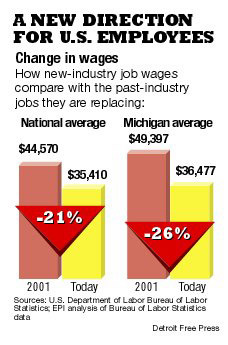 Since January 2001 the US economy has lost 3.2 million private sector jobs including 2.5 million fewer manufacturing jobs. In the next ten years we could lose three million more jobs. In my home state of Michigan, we have lost over 162,300 manufacturing jobs, roughly one-fifth of our entire manufacturing base and unemployment not stands at 7.4 per cent, fourth highest in the country.
And now we are witnessing many companies resorting to outsourcing. Their higher profit margins are indicative of the lucrative nature of this global business strategy, but it also underscores the fact that even service and tech jobs are fleeing Michigan. We could eke out a living by selling burgers and fries, but people need jobs to be able to buy burgers and fries.
We are experiencing an economic recovery, but without job creation. Whatever the reason for the recovery, low interest rates, tax cuts or reduced value of the dollar, can we continue to allow our economy to lose jobs.
As things get worse, the US government will have to intervene to make adjustment for market failures. Already the Senate is considering a bill that seeks to plant hurdles in the path of companies resorting to BPOs. The senate has already passed a bill that restricts federal contractors from outsourcing work overseas. The president had made an attempt to impose tariffs on steel imports that had to be reconsidered when faced with retaliatory sanctions by the European Union.
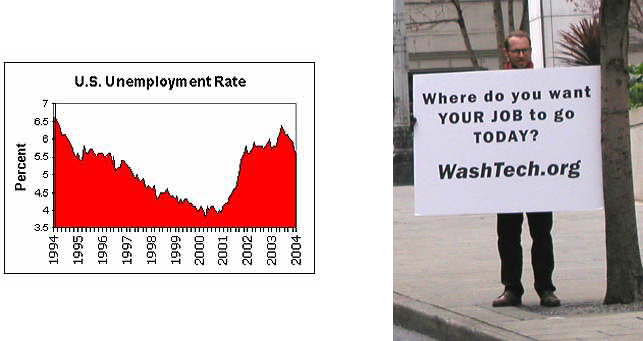
As the pressure mounts, the government will have to intervene and impose limits on free markets and free trade. We have seen how other nations, Malaysia and Argentina, have chosen to restore control on capital mobility when faced with economic crises stemming from the ill effects of rapid globalization. As globalization turns out to be a double-edged sword that cuts both the Third World as well as the advanced economies, will we also learn to live in a less free economy as we are learning to live in a less free polity?
I worry that terrorism and globalization, Al Qaeda and WTO may in tandem, shrink our free society. We cannot allow that. The coming elections provide us with an excellent opportunity to discuss the fundamental challenge that America faces today — the threats to democracy and free markets.
Let us abstain from making this election a petty dispute over military records or a cultural war over gay marriages. Let this election be what it must always be — a democratic ritual that works towards strengthening the free society. Let us make it a debate about how America will restore its democratic and economic health.