Previous Story
The Remarkable Moderation of Detroit Muslims
Posted On Jul 04 2004
Comment: 0
This article was published in The Detroit News July 4th, 2004, The Daily Star (Lebanon) 07.07.2004, The Daily Times (Pakistan), 06.25.2004, Pakistan Link(US) 07.04.2004, Q-News (UK), July 2004.
The Institute for Social Policy and Understanding (ISPU), a Michigan-based think tank, recently published a survey of the character and opinions of mosque-goers around metropolitan Detroit. The findings of the report underscored the remarkable moderation of mosque-goers on politics, public policy and Islam. The survey provided some scientific basis for a claim that moderate Americans have been making all along – that the vast percentage of American Muslims are liberal and their presence in America is economically, politically and culturally beneficial. Allegations that American Muslims may constitute a fifth column are beginning to look increasingly shallow.
ISPU was set up by concerned citizens from Michigan who are interested in advancing socially responsible and morally critical analyses to help American leaders make better public policies. Their key concerns are providing intercultural understanding, fostering multiculturalism and pluralism, advancing respect for human and civil rights in America, contributing to human development, understanding scientific progress and fighting poverty and social marginalization.
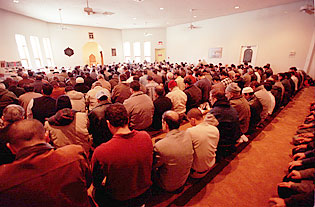
A packed Friday congregation at the
Islamic Association of greater Detroit.
This survey now provides some scientific basis for the claim that most American Muslims are liberal — pro-democracy, comfortable with their American identity and willing to be critical of themselves — and their presence in America is economically, politically and culturally beneficial. Allegations that American Muslims may constitute a fifth column are beginning to look more and more shallow.
The study provides an interesting profile of the active Muslim in the Detroit area. The average participant in a mosque is 34, is married with children, is well-educated, is an immigrant or born to immigrants, makes more than $75,000 a year (but is a little stingy when it comes to giving to mosques), is either progressive (38 percent) or traditional (28 percent) in religious practice. The average Muslim is also politically conscious (68 percent registered to vote), a bit ethnocentric — there is some evidence of ethnic clustering around mosques — and is a political liberal (supports affirmative action, universal health care and tough environmental protection laws) but is socially conservative (worried about sexual promiscuity).
According to the institute’s report, there are 33 mosques in Metro Detroit, up five in the last three years. The average number of people associated with each mosque is about 1,968, which means that roughly 65,000 Muslims attend mosques and mosque-related activities. Based on this count, the institute estimates 125,000 to 200,000 Muslims live in Metro Detroit.
I think this number is a bit low; the estimate relies on a rather dubious claim that one third of Muslims attend mosques. There is no scientific basis for this figure, except the optimism of some Muslim researchers about the high religiosity among Muslims.
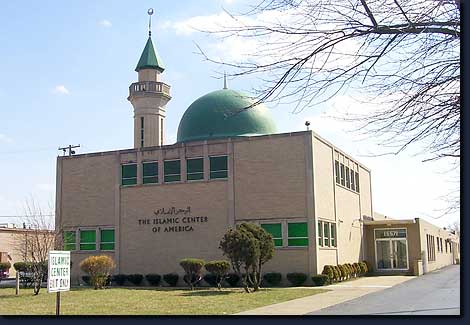
The Islamic Center of America, Detroit Michigan
The study’s most important contribution is the survey of attitudes toward Islam. According to the survey, 38 percent of Detroit Muslims adopt a flexible approach to understanding Islam. This is a very important and promising result.
When Muslims adopt a flexible approach, what they essentially imply is that place and time must have an impact on how religious sources are interpreted. This allows the American experience to shape Islamic practice and often leads to greater gender equality in mosques, a more positive attitude toward democracy, freedom and human rights.
This attitude also fosters better interfaith relations and higher engagement with the mainstream culture, politics and society. These Muslims provide the necessary community support for developing progressive and liberal Islamic movements, institutions and ideas.
According to the study, only 8 percent of mosque participants who filled out a questionnaire identified themselves as Salafi — extremely conservative and narrow-minded. These Muslims practice gender discrimination and segregation as divine law and believe all non-Muslims including Jews and Christians will go to hell unless they embrace Islam.
The study celebrates this fact and concludes that conservatism and radicalism may not be present among Detroit Muslims.
However, one must consider the possibility that many Salafi Muslims may not identify themselves, recognizing that in the post-September 11 environment it may be an invitation for unnecessary legal scrutiny. Salafi Muslims usually are also anti-American.
Interestingly, more than a quarter of mosque participants identified themselves as followers of traditional Islamic scholars, which really means that they adhere to a fossilized interpretation of Islamic laws. They think the opinions of scholars who lived more than 500 years ago are more valid than those of contemporary scholars, making current realities irrelevant. Strong adherence to classical positions is also insensitive to contemporary demands for religious pluralism, gender sensitivity and modern conceptions of nationhood and citizenship.
The combination of traditionalists (with many Salafis probably choosing to hide in this category) and Salafis really make Detroit mosques as much conservative (36 percent) as progressive (38 percent). This situation could really make Detroit mosques a battleground for the proverbial soul of Islam.
The character of the mosques therefore will be determined by the influence exercised by Muslims who are theological freelancers (25 percent). If they lean to the past, the conservatives dominate; if they look to the future, the progressives will prevail.
Finally, I am glad to report that Muslims who have advocated participating in American mainstream society and politics have finally achieved a decisive victory (with some help from the Patriot Act, which restricts civil liberties) over anti-American isolationist Muslims, who advocate an Amish-like existence. According to the survey, 93 percent of mosque goers say Muslims must engage in politics.
The findings of this study have one big bias. It surveys only those “one-third of Muslims” who go to mosques. Mosque goers are easily more conservative than those who do not.
While mosque attendance may not determine favorable attitudes toward America, it strongly affects social, cultural and even political views. Thus it is heartening that even among religiously conservative Muslims (those who attend mosques), 38 percent are progressive and 25 percent are free lancers (flexible).
The American Muslim community is going through a significant transformation. Studies like that of the institute do a great service by providing a glimpse into the changing soul of American Islam. Hopefully, more studies will give a better picture of Muslims and help fight the suspicions and fear that September 11 has generated among other Americans.